


To generate more conversions in a Google Ads Search campaign, you should focus on driving cost-effective conversions by optimizing your campaigns. To drive high-quality conversions, you need to refine your ad copy, improve audience targeting and keyword selection, and enhance the landing pages visitors arrive at. In this article, we will go over five additional ways you can fine-tune your Google Ads Search campaigns and use them to generate more conversions. Advertising on the Google Search Network is a channel full of opportunities, and proper campaign optimizations will help you achieve better performance.

5 Tips for Google Ads Search Campaigns
Although Search campaigns are text-based and that is what users actually see, behind the scenes, campaigns look entirely different, and these ads can succeed or fail based on the actions you take. Assuming you already have active campaigns running, use these 5 optimization methods for Search campaigns to take your existing campaigns to the next level:
1. Negative Keywords
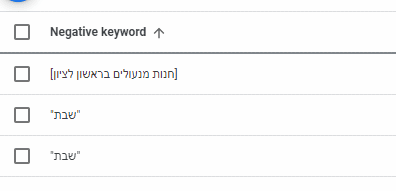
One of the things in Google Ads that people tend to overlook or mismanage is negative keywords. If you are using broad match for your campaign keywords (not recommended at all), you will be surprised to discover how many triggered search queries are irrelevant to you or your business, negatively impacting campaign performance. There are 2 main reasons why using negative keywords is an effective action for your campaigns:
- Negative keywords significantly reduce search terms that are irrelevant to you, ensuring the budget is better utilized for terms that are relevant.
- Using negative keywords improves additional campaign metrics like click-through rate (CTR) and Quality Score, which ultimately impact the quantity and quality of conversions.
To perform one of the most recommended and effective optimizations in Google Ads, I suggest checking your campaign search queries at least once a week to find new negative keywords you need to add. Regularly updating negative keywords will keep your CTR high and maintain a good Quality Score for your ad.
2. Ad Rotation
Ad copy is a craft in its own right. Fortunately, Google provides tools to help you optimize your copywriting strategy. Your ad group might have only one or two ads, and you might not have updated your ad copy recently. Optimizing ad rotation can pay off in the long run. Ad rotation optimization is a setting offered in Google Ads that allows Google to automatically rotate between multiple ads to serve different components of ad content at a certain frequency, while prioritizing the top-performing copy elements.
The primary goal of Ad Rotation optimization is to reduce the workload of ad management and allow you to test more headlines and descriptions in the ad copy without running manual tests yourself (pausing, deleting, and updating regularly). To start applying this optimization, you can enable ad rotation at the ad group or campaign level.

3. Automated Bidding
One of the most well-known automations in Google Ads is automated bidding. Identifying the right bid for each keyword in your account can be very difficult, and trying to manage a large volume of keyword bids can make manual bidding suboptimal. Fortunately, an automated solution exists to make our lives easier. Google’s Smart Bidding—the automated CPC bidding solution—allows you to optimize based on your desired outcome. You can configure your bid strategy to increase website traffic, boost impression share, maximize conversions at a target cost per acquisition (CPA), and more.

4. Data-Driven Attribution
Most people start campaigns configured with conversion tracking on a last-click attribution model. An attribution model determines how conversion credit is distributed among the campaigns in the account, whether to the last click (Display and Remarketing usually take all the credit) or other models. You may want or need to work with other types of conversion attribution depending on the nature of your business. Suppose you sell a complex item online like a wedding ring – users will likely do research before making a purchase on your site, and you wouldn’t expect the user’s first search to immediately lead to the purchase. After searching and browsing various sites, the user chose to search for your brand and return to your site to complete the purchase.
In last-click attribution, the user’s conversion will not be attributed to the initial campaign, even though without it, the user would not have been exposed to the fact that you sell wedding rings. This is where other types of conversion attribution can benefit you. Google offers an analysis tool called Data-Driven Attribution, where you can see the difference between the user’s last click and their other interactions with your ad and website. To set up data-driven attribution for your account, go to Tools and Settings, click on Attribution, and on the right side click on Switch to Data-Driven Attribution. This way, you can find out which attribution model is most suitable for your campaigns.

5. High Volume of Testing
The previous recommendations in this article were specific to certain features in Google Search Network PPC campaigns. This recommendation is broader for improving your campaign performance in general. It is crucial to run tests on everything possible in your Google advertising account. By testing different elements in the account while running campaigns, you will gain new and relevant insights about your audience, landing pages, and additional optimizations worth implementing in your account.
A good example of a relatively small test you can run in your ad account is using ad rotation, as mentioned above. Using ad rotation to test ad copy is a great way to continuously test and improve your copy. An example of a slightly larger test is landing page testing – create landing pages and run an A/B test to see which page generates a better conversion rate. Testing landing pages, ad copy, audiences, and other elements is an excellent way to gain new insights into your business and drive it forward.
Summary
Creating a Google Search campaign is not overly complicated. The bulk of the work on campaigns is optimizing everything possible in the account. Optimization is an ongoing process, and improving Google campaigns does not happen overnight. In this article, we went over five ways to improve your campaigns. Apply what is relevant to you, as some small businesses might not need to run a large volume of tests or may not have enough products or services that require a massive amount of ads.
About the Author
Dvir Naaman, 27, graduate of the Digital Marketing course at HackerU College. Experienced in WordPress website development, paid advertising on Google, Facebook, YouTube, and TikTok. Specializes in Search Engine Optimization (SEO) at Fialkov Digital. Has rich experience in eCommerce and dropshipping, and is the owner of Merchant Center – a website consolidating information on eCommerce platforms and advanced marketing systems to increase business conversions with an emphasis on eCommerce store sales.
