


At the Update Upgrade conference, Yan (Yanko) Kotliarsky, Director of Marketing at accessiBe, manager of the blog yanyanko.com, and manager of the Digital Advertising Professionals group, gave a lecture on marketing strategy in the digital age
What makes a brand succeed?
I started getting interested in how the brands we know today started and reached their current state. And I asked myself 2 questions:
♦ How do brands grow?
♦ What makes a brand succeed and what makes it fail?
I started going back in time in the marketing and advertising world. The furthest I got was to 1927, to a guy named Claude Hopkins who wrote the book “Scientific Advertising”.
The quote that really caught my attention in the book is – “People have no time for you” (and that was in 1927). A penny began to drop, that human beings don’t change. We think we change – but we don’t. So I started reading and understanding how brands grow based on this understanding that people have no time for advertisers and brands; it was true a hundred years ago, and it is true today.
In the article, I will explain how to implement and what strategy actually means for your business.
The Goal: How to build a marketing plan in the digital age?
Sample campaign: Promoting country club memberships.
- Budget: 25,000 ₪
- Reach: 60,000 views
- CPM (Cost per 1,000 impressions): 415 ₪
- Number of inquiries: 800 leads
- Inquiry rate: 1.33%
- Cost per inquiry: 31.25 ₪
- Conversions: 120
- Cost per conversion: 6.66 ₪
- Conversion value: 10,000 ₪
- Total conversion value: 1,200,000 ₪
- Return on investment: 48x.
In the lecture, I asked the audience which advertising channel they thought we used to achieve the above results; we heard Facebook / Google / Instagram / and a variety of great platforms. But no one managed to guess the correct advertising channel.
The advertising channel used was flyers – not everything is digital
The Marketing Plan
A marketing plan must be based on three stages: situation analysis, strategy, and tactics / execution.
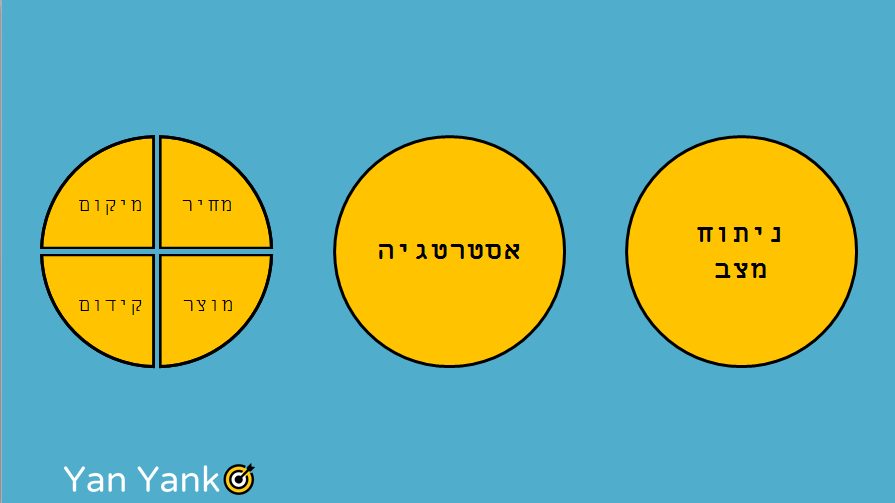
Most businesses focus on tactics / execution (flyers, billboards, digital, print, sponsored prizes, radio, direct mail, television, content, etc.), even before performing situation analysis and strategy, and that is wrong.
Traditional Marketing vs. Digital Marketing
Today, people tend to distinguish between traditional marketing (Offline) and digital marketing. In my opinion, there shouldn’t be a difference, because the day is not far off when you can launch a billboard campaign through a platform like Facebook Ads. However, there is a difference between these 2 marketing methods; you need to know how to address the audience in each marketing form. Both traditional marketing and digital marketing should be used.
Traditional Marketing
The advantages of traditional marketing are that it enters our subconscious and has a broad reach.
Its disadvantages are a high entry threshold, almost impossible to measure results, limited segmentation capability, and no audience interaction.
Digital Marketing
The advantages of digital marketing are numerous: you can accurately target the audience you want to reach, low entry barrier, ability to remarket to the customer in stages, easy measurement.
Its disadvantages are the multiplicity of channels, difficulty measuring attribution, frequent updates, and difficulty standing out.

Case Study - Zuki Pizza
The Client: Zuki Pizza
Mark Zuki decided he wanted to open a pizzeria. He found a place, renovated, invested, hired employees, got equipment, ingredients, and in a few months will be ready to launch.
Zuki turns to me and asks: “Yan, so what do you think, Instagram? TikTok? Bring in influencers to eat at my place? I heard that Facebook is really cheap! Can we make a viral video? Maybe get a cat to eat pizza? Maybe do voice search? What about AI? VR? ROI???”
First of all…
Before we start marketing and appearing on all existing platforms, we must act in three stages:
- Situation analysis – where are we now?
- Strategy building – where would we like to get to?
- Tactics – how will we get there?

Rule #1 for Marketers:
First of all, come with an “I don’t know anything” approach.
If we start the work of situation analysis and generally understanding the market with our preconceived notions, we are starting the work incorrectly from the outset; we kind of project reality as we see it onto our client. The client, too, must admit that they know nothing about their audience because they live it day to day.
We, the marketers, must enter in the clearest way possible and without preconceptions; a preconception ruins most of our work and usually turns out to be wrong. In the situation analysis stage, we want to understand where we are now: who am I, who are my competitors, who are my customers, and what is the market I am targeting.

Market, Competitors, and Customers
To understand the market, we need to learn who our customers are: Where do they order from? What are they satisfied with? What are they less satisfied with? How do they search? What will make them try something new?
Additionally, we must examine our competitors: delivery speed, taste, quality of customer service, prices, value for money, delivery distance, and more. And you need to ask these questions to their potential customers, not “guess” what their answers will be. We need to understand what our customers’ needs are and what we can answer, what is our special thing that can make people notice us – that’s where we reach the Sweet Spot.

Strategy – What are the goals?
Its first goal should be “to make me known”. A goal needs to be something very defined and specific, not a vision or aspirations. It must be measurable. It must be achievable, a realistic goal, challenging – but realistic. And it must be time-bound.
Then we can ask the following questions: From whom do we want to achieve? What do we want to achieve? And within what timeframe do we want to achieve it? And the goal must be measurable and time-bound.

Who is the customer?
The only way to understand who the customer is, is to ask the customer.
Anyone can be your potential customer; when you get the answers after the research – you will be in shock,
and realize how much your “personal belief” does not apply to everyone.
Using the research we conducted, you will be able to find the Sweet Spot, which is a point where I approach the customer with something, something relevant to them that I know they want,
and that’s something I know competitors are not doing.

What do we want to achieve?
We must choose the right goals for the business. A new, unknown business’s first goal is to become known, and then to get people to come and buy.

We must select goals for the upcoming year according to the definition of “goal” that we wrote above.

How will we convince the customer?
The funnel shown below describes how humans behave,
First, you need to grab our attention, then explain to us what you want us to do, and then give us a reason why we should do it.
The problem and also the goal of most advertisements is to grab our attention,
For example, most of the ads we see every day – we don’t remember; those that we do remember, we don’t always remember the brand name.
Therefore, the first goal of the advertisement is to grab the user’s attention, and only then can we explain to them what we want from them and why they should do it.

Promotion and Marketing
After analyzing the situation and building a strategy, how do we promote?
There are various and diverse channels for business promotion: email, outdoor advertising, radio, direct mail, website, and more… The more channels chosen, the more revenue increases. It is recommended to go with at least two different channels. Choose and get started.

So how do we choose among all the options?
A study conducted by Analytic Partners between 2010 and 2015 examined 3,200 different campaigns and reached the following results:

This graph shows that the more advertising channels used, the higher the revenue. So our recommendation is to launch with as many advertising tools as possible, according to financial capability and the nature of the product, of course.
Summary

Situation analysis – strategy – tactics. This is how businesses grow. Most businesses fail because they “skip” the first 2 stages. Throwing a lot of money at advertising is not the problem; the problem is building something that will still be here in 20 years.
A little about me
Yan (Yanko) Kotliarsky, Director of Marketing at accessiBe. Happily married to Ravit, co-manages with Or Fialkov the Digital Advertising Professionals group (the largest group in its field in Israel), loves to research the marketing world and understand what makes people make decisions.
