


Organic promotion on Facebook and Instagram sometimes feels worthless, so why should you still invest in organic content? Although we are in favor of posting content to social media regularly, we also believe it should be given an extra boost from the paid side. But for this matter, we focus in this article on creating content on a regular basis for your or your clients’ Facebook and Instagram pages, regardless of whether you plan to promote it or not (although, as mentioned, we recommend doing so) and how it can benefit us.
One of the most frustrating things for quite a few business owners who create social media content and do organic promotion on Facebook—unlike paid advertising on Facebook for example—is the drastic drop in organic reach. Usually, this comes with all kinds of complaints like “Zuckerberg only wants money” and similar remarks, leading to giving up, investing resources solely in performance activities, and completely neglecting social networks. So before we dive in, it’s important to qualify and say that yes, organic reach is pretty much dying. At the same time, there are pages that manage to generate insane engagement for various reasons, yet they are probably not the majority. Because I don’t like throwing empty slogans into the air, I will touch upon some of the reasons why it works for others, even though this is not an article that is going to teach you how to increase your organic reach.
- An experienced social media team that knows how to create and tailor content precisely for the target audience, which leads to countless comments, shares, and tags in the first circle exposed to the content (and following these actions, Facebook rewards it by expanding the organic reach circle).
- Pages that have accumulated a huge amount of followers over the years, giving them a relative advantage, as the initial circle of users exposed to the content is much larger than business pages with a smaller follower count—which significantly increases the chance that this circle will interact with the content and signal to the algorithm that the content is good in order to expand distribution (relates to the previous point, of course).
- Performance-based campaigns that make users not only interact with the ads themselves but also want to follow those pages, leading to exposure to new audiences who have just liked the page (and assuming they interact with new content posted, they will continue to see it).
But let’s put all of that aside, because that is not the essence of the article and not the rule, but unfortunately, the exceptions.
Organic Promotion on Facebook and Instagram - 4 Reasons Why It's Important to Invest in It
So why is it still important that even if we have relatively small or completely new pages, we invest in our social media activity and do organic promotion on Facebook and Instagram? Why should we spend energy, time, and money on this activity if we know that the gods of the algorithm and reach are probably not on our side? Proper work with content promotion will lead to more relevant users interacting with and following our pages, which allows us to target them in various campaigns. By the way, this is a primary reason why we would never buy likes or followers and pollute our data.
We have gathered 4 reasons to convince you to invest in “organic” content on social media:
First reason: We want to be relevant
If you’re like me, you don’t immediately click the “Leave Details” or “Buy Now” button when you see an ad you like. If I come across content that interests me on a performance level because someone targeted me, I want to do a little research and see who they are and how legit they, the product, or the company are. I’ll check out their Instagram or Facebook (or both). I want to see the content they post—the stories, the reels, the posts being uploaded. If I visit such a page and see that the last post uploaded was a year ago, it can make me take a step back and hesitate whether to buy, leave details, or whatever action that performance activity is trying to achieve.
A well-maintained social media asset shows relevance and conveys that there are real people here working on content, making it feel less like a ghost page. It simply conveys more credibility. In addition, you already know that one of the best ways to create growth engines for a business is referrals from satisfied customers. If a satisfied customer now recommends your service or product to a friend, there is a high probability they will go to Facebook and Instagram to do a little stalking. As long as there’s a chance they’ll do that, you want them to land on a page that radiates relevance, right?
Second reason: We don't necessarily know at which point the user meets us
Are they already ready to purchase a product or service similar to ours? Are they only at the beginning of their journey and currently exploring to see if we are the right people for them? Since we cannot necessarily know this, we do want to generate enough content on a regular basis so that we can address their needs across our social assets at the different points of the customer journey they are in. I will try to illustrate it as follows:
A user searched for content on a specific topic on Google—let’s say they searched for a PPC course. They landed on an article on my website about a PPC course, read the article, and were impressed. Suppose that user is less into Facebook, but lives on Instagram. On my site, at the end of that article, there are “Follow me” buttons for all the social networks I’m on. They click on my Instagram because after all, they really liked the article, but they aren’t sure that my course is necessarily the right course for them. From the site, they enter my Instagram, see that there is interesting content, and start following me. I continue to upload interesting content, stories, reels, posts (of course within a proper content plan). That user, who has already decided to follow me because the article they read interested them and the content they encounter when entering Instagram speaks to them, continues to consume content from me that slowly establishes me in their mind as the right place to take the course they want and that I teach.
Note the attached example – an activity that is primarily performance for a coaching client we work with, yet at the same time, we do not neglect that client’s content world. Look at how the user who reached out to them opens the conversation:

What do we understand from this? That he was recently exposed to our client and all this time he has been following the content. Look at how it continues:

Do you already see where this is going? (Towards a close). Now, look at what happened here. The user was exposed to our client through one of the channels we manage for them. They started following the client, consumed the content, simmered and nurtured until they initiated contact themselves, and from here, the path to closing becomes much shorter.
What would have happened if there was no social media activity? Probably nothing, because what do we know from this situation with certainty? That the first point of contact with our client interested the user enough to want to learn and consume more content on the topic, but did not cause them to leave their details. And if there were no social activity, they probably wouldn’t have turned into a closed deal lead, because we know after all that they didn’t submit a lead from the campaign they were first exposed to or from visiting the website…
Third reason: We can't know if the very next piece of content we make will be the one that blows up.
Anyone who says there is a proven formula that works 100% of the time for creating viral content is lying to you. The truth is that no one can really know what will make the next post blow up (if at all), but as long as that chance exists, why should we ignore it? True, we won’t just sit and wait for tomorrow’s post to blow up, go viral, or get massive reach, but the more we create better content tailored to the target audience, the greater the chance of that happening. It’s important to know how to leverage the tools that Facebook and especially Instagram offer us, and to know how to work with the various features available.
We know that Instagram currently favors Reels with higher organic reach, right? Let’s create content tailored for Reels. True, it doesn’t mean that same video will get a million views tomorrow, but assuming our audience is there, isn’t it worth trying? Take a look at the attached image—social media activity for a client on April 1st; look at the respectable organic reach for the post we uploaded. (23k)
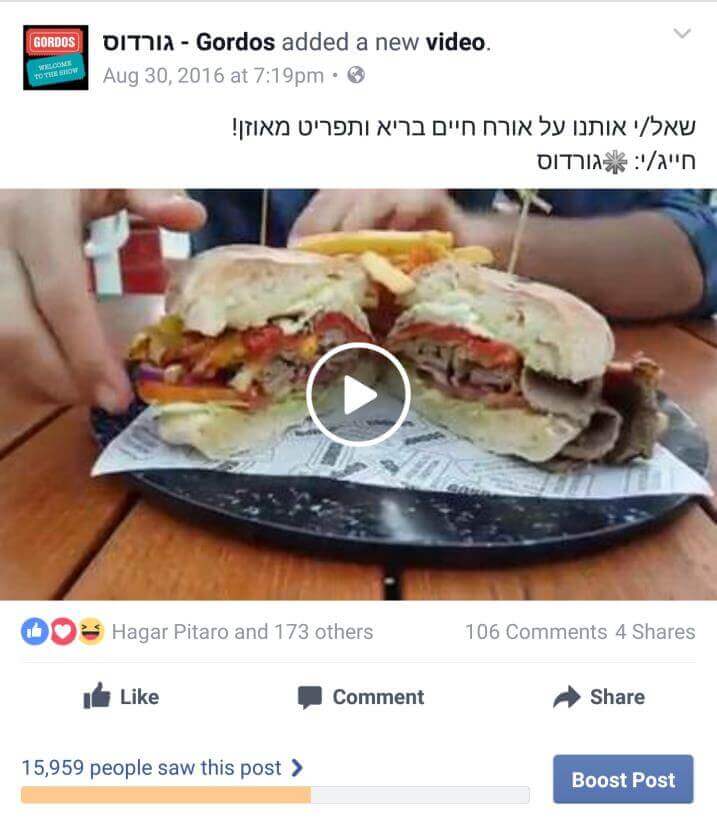
This isn’t about a contest, nor is it an engagement-bait type post, and the like. By the way, because it was executed precisely and we didn’t mention April Fools’ Day, the post generated quite a bit of interest from clients who reached out to check if it was a real product.
Fourth reason: Using interaction-based data for our campaigns
Here, you need to be very, very careful. On the one hand, we have the ability to build audiences based on various actions users take on our Instagram and Facebook and use them in campaigns; on the other hand, it is very easy to burn this data and pollute it. For example: You uploaded a post that you want to promote. You defined a target audience and published the campaign. You do this both so that it reaches as many relevant eyes as possible, and so that later you can generate data from anyone who interacted with your content.
The risk: If that content promotion campaign is not as accurate as a Messi top-corner strike, and you essentially get a lot of interactions from an irrelevant audience, then in the next stage you will not be able to use this audience or create a Lookalike from it because it will be “polluted”. Therefore, it is very important to know how to do things properly, so that you can indeed build an audience from those interacting users for further, more accurate performance activities. If the content we upload genuinely interests users, they will also start following us as a result of our promotions, allowing us to create more accurate targeting audiences from those followers while simultaneously enjoying new traffic of users exposed to our organic content. Look at the audience we are targeting in this ad set: all are audiences we gathered through content

Look at the results:

And the same audience in an ad set in another campaign:

Summary
Look, organic reach is not at its peak, to say the least; we’re not arguing about that. But even an aging player past their prime can make the assist that leads to a game-winning shot, right? Are you performance-focused? Great. But if possible, I highly recommend combining ongoing social media activity and doing organic promotion on Facebook and Instagram as well. Even if you need to allocate part of the budget to it so that the content reaches more eyes. Ultimately, users do visit your social media pages, and once there, it’s best to have content waiting for them that nudges them a bit closer toward the action you ultimately want them to take.
Article Author
Yoel Doron, Owner of Doron Media – a digital agency specializing in social, content, and performance.
Blogger and host of the podcast “Clickable“ on digital marketing and entrepreneurship.
